Category Archives: Uncategorized

Integrating user support for eResearch services within institutions (AeRO) #theta2015

Integrating user support for eResearch services within institutions. Lessons learned from AeRO Stage 2 User Support Project (abstract)
Hamish Holewa and Loretta Davis

AeRO = Australian eResearch Organisations – cooperative to deliver national services to researchers. Set up a user support project.

User support is often fragmented. Wanted to make a joined-up network. How-to guides, who to go to if there’s an issue, how to support services being designed to provide service to end-users.

Presented a maturity model to ap service providers for increasing maturity. For ap developers at first it’s about getting the ap and running (many have only been released in beta). AeRO user support say they understand this but here are some things you need to think about moving forward.

Outcomes – service maturity model and the “AeRO Tick” for service maturity in practice (self-assessment tool that shows you where you can grow). Incident management and ticket transfer framework. Uni IT Research Support Expert Group formed. Service catalogue definitions – how do you describe these services?

Lessons learned:

  • Maturity models work well: non-accusatory, acknowledges efforts already taken, and gives people a clear pathway forward
  • Sector-wide progress is gaining momentum: approx 65% of services have level 2 maturity (of 3 levels)
  • Value of cross-sector initiatives: wanted a central ticket system but though this sounds like a good idea heaps of work and doesn’t work well, but better to invest in templates, protocols, communication so can transfer tickets to other providers in a standard way.
  • Enable representative groups to inform/change project
  • eResearch Uni IT Expert Group: informed outputs of the maturity model and ways to integrate into institutions. Pointed out not all institutions work the same or even care.

Future: Possibilities to expand the maturity model, expand services in the service catalogue and further engage institutions.

Changing times, emerging generations: a snapshot of the megatrends affecting higher education #theta2015

Changing times, emerging generations: a snapshot of the megatrends affecting higher education
Mark McCrindle

[More details on changing demographics which tends to be of little interest to me because so abstracted from personal reality – it’s hard for me to get beyond “Yeah so?” especially because any “And so”s developed from this tend to be such vast generalisations about Generation [letter] that I’m automatically sceptical. When you talk about the “Facebook Generation” – not that Mark does but to follow my chain of thought – you miss out all the people who didn’t grow up with computers in the home which is really dangerous in terms of equality. However I did like the saying he quoted that “If you’re leading and no-one’s following, you’re just out for a walk.”]

Waves of the Future: Possibilities for Higher Education #theta2015

Waves of the Future: Possibilities for Higher Education (abstract)
Bryan Alexander @bryanalexander

  • Now always need to assume possibility for a backchannel – need to be prepared to take advantage of this.
  • Battle of the brands – the i-devices, Microsoft’s, Google’s, Amazon’s… But humans like to cut across vertical stacks (giving IT departments many challenges)
  • Post-Snowden: “Humanity has awoken to an Orwellian nightmare with a great ‘…Meh.'”
  • Smaller trends: digital video, cloud wars (a few years ago a frenzy of “What is it, what does it mean, is it dangerous” and then we all just moved there), augmented reality, automation and artificial intelligence. Social media (vs ‘anti-social media’)
  • More: crowdfunding/crowdsourcing; copyright battles; Moore’s law continues to work; office vs web office
  • Design for mobile first. PCs getting crowded out. Mouse and keyboard use declining. 3D printing enormous – may cause decline of shipping containers.
  • Neat image of computing being broken into little pieces that we “smear around our bodies” – devices clipped on shoes, around wrists, in earbuds, glasses, ….
  • Ebooks and print books existing side-by-side – don’t know if this is a plateau (e-textbooks haven’t taken over) or ebooks will continue to dominate
  • Demographics shifting from pyramid (more young, few old) to stack (about the same number in each five-year slice). Economy changing from one job/career to a series of gigs. Inequality on the rise again — huge impact on education.
  • How do we respond to this? What do we prepare students for (other than student debt)?
  • Teaching and learning and tech: blended classroom, gamification, companies starting up to make money in education (“which seems crazy but there it is”), growth of digital humanities research, MOOCs – gone through a media crash but still grow though we don’t know how to assess them or pay for them but we keep making them and people keep taking them. How much reading is being done; (how) are literacies changing?

Which of these trends are most reliable? Which are most unpredictable?

  • What if Open wins? -> rise of the sharing mindset; gig economy, sharing labour as well as content; global conversations increase, more creativity, information cheap, academic content unleashed on the world, industries collapse, authorship mysterious. Some higher costs, tech challenges, outsourcing and offshoring
  • What if Closed wins? (eg if user preference for simplicity and convenience; failure of open business models, closed source outperforms open) -> huge content industries; ferocious IP policies; surveillance and intrusion protection; simpler computational hardware; anti-hacking policies; elaborate identity mechanisms; widespread micropayments; on campus publishers are locked in and powerful, security protocols in place, large role of business
  • What if automation wins? -> tutoring software, commodity AI, boom in CS/robotics departments. News articles are being written by bots – what happens when they’re writing books?
  • What if a renaissance? -> boom in creativity through storytelling, gaming, mobile devices. Games for teaching, game studies as academic field, libraries archive games, ‘gamification’ is taken for granted

Towards 2020: Making the Most of Your Research Data #DSShowcase

Summary: One of the themes coming out of the day was that the New Zealand research sector is in a unique position to collaborate to develop the policies, infrastructure and best practices we need to treat our research data as the valuable asset it is. It’s really noticeable how each time we get together for talks like this, there’s been more progress made towards this ideal.

(Day hosted by Digital Science. Notes below are ‘live-blog’-style; my occasional notes are added in [square brackets].)


Daniel Hook – Perspectives on Data Management
Remarkably little has changed in how we store research data since the days of wax tablets. Data is highly volatile: much thrown out or just lost.

Currently all kudos in publication; none in producing a good reusable dataset. Will never get to be a professor because you’ve curated a beautiful dataset.

UK – all scoring and allocation of money based on journal publication – terrible for engineers who are used to publishing in conferences [and presumably humanities who publish in books]. Engineers tried to game this by switching to publishing in journals, but got terrible citation counts because it split the publication sites and didn’t suit global publication norms for the field.

“The Impact Agenda” – various governments trying to quantify (socioeconomic) impact. Sometimes of course this impact occurs years/decades later. And the impact agenda forces us down some odd routes.

REF Impact Case Studies – http://impact.ref.ac.uk/CaseStudies/search1.aspx – includes API and mapped to NZ subjects.

Publish a paper, want to track:

  • Academic Attention (job; paper, public talk)
  • Popular Attention (Twitter, social media, news)
  • Enablers (equipment, clinical trials, funding)
  • Routes to Impact (patent, drug discovery, policy

Ages of research: individual; institutional; national; international. [citation] This makes it difficult to know who owns the research/data.
Daniel’s take: unregulated era; era of evaluation; era of collaboration; era of impact. This last is actually a step backwards, especially because typically driven by national governments so at odds with globalisation of research community.

Big data – a good way to get grants… However while it’s the biggest buzzword, it’s not the biggest problem. It’s challenging but a known problem and a funded problem.

Small data is the bigger problem. (aka “the long tail” problem). Anyone can create small data, and it’s mostly stored in a pen drive in someone’s desk, rarely well backed up. Some attempted solutions (figshare, DataDryad, etc) but thin end of the wedge.

Three university types:

  • just want to tick the box of government mandates – so data still locked away
  • archival university – want to preserve in archival format. Expensive infrastructure, especially to curate
  • aggressively open – making data openly available at point of creation.

Manifesto:

  • capture early
  • capture everything
  • share early
  • structure the data

Nick Jones (NeSI)
Want to pool resources nationally to support researchers

Elephants in the room:

local and rare (unique datasets; funded by research grants) shared but rare (facilities: Hubble/CERN; national and international funding)
local but ubiquitous (offices, desktops: instututional funding) shared and ubiquitous (TelCos: commercial investment)

Challenge to build a connecting e-infrastructure. [from diagram by Rhys Francis]

Various ways of breaking down the research lifecycle and translating this into desirable services. Often no or little connectivity between such services. Cf EUDAT

Three Vs: Volume (issues include bandwidth, storage space; cleaning; computationally intensive); velocity (ages quickly); variety. [from NCDS Roadmap July 2012)

Europe doing a fair bit. US just starting to think about a “The National Data Service”. Canada has Research Data Canada which has done a gap analysis. 7 recommendations from the Research Data Alliance including “Do require a data plan” but also “Don’t regulate what we don’t yet understand” [The Data Harvest].

eResearch challenges in New Zealand

  1. skills lag
  2. research communities – strategy needs to fit with needs of different disciplines
  3. aligning incentives
  4. future infrastructure

NeSI is addressing this last by putting in a case with govt. Want a consultative process over this year, case to govt by Q3. Others also stepping up, including CONZUL – good to see developing around this.


Mark Costello: Benefits of Data Publication

People once got angry about being asked to put their stuff up on the internet [still do!] Now get angry when stuff they put up gets used in others’ research – don’t see it as having published but having put it up in a kind of shop window.

Why make data available?

  • better science (independent validation; suppliementation with additional data; re-use for novel purposes)
  • save costs (don’t need to collect again; some data can’t be collected again; don’t need to deal with data requests)
  • discourage misconduct
  • [later mentions increasing profile of researcher / institution, encouraging others to come work there]

Cf system when discover new species – you have to deposit specimen to a museum and can’t publish without an accession number.

Talks about data publishing, not data sharing: people understand the word ‘publication’ and its attendant rights. Well understood process; provides access, archiving and citation; deals with IP; no liability for misuse; increases quality assurance; meritorious for scientists.

Could publish on website, institutional repository, journal, data centre. Considerations: permanence, quality checks, standards, peer review. Journals do peer-review but don’t necessarily follow standards. Data centres follow standards but don’t neceessarily have peer review.

What about publication models? Need an editorial management system; archiving/DOIs; access/discovery tools; open access but who pays cost?

Need a convergence between people with IT skills to manage a data centre and people with editorial/publishing process skills to get a viable data publication process.

Q: What would incentivise data publication?
A: DOIs, peer review. Peer review isn’t actually that difficult: look at the metadata, run statistics to check columns add up, etc. Much can be automated.


Ross Wilkinson (ANDS)
Trends in research data:

  • becoming a first class research output – sometimes even pre-eminent
  • valuable
  • a commodity in international research (cf rise of Research Data Alliance)
  • can be made more valuable eg moving from data (unmanaged, disconnected, invisible, single use) to structured collections (managed, connected, findable, reusable)

Funders are seeing data as publishable and expect it to be managed.

Role for research institutions: data used to be considered a researcher problem, dealt with as project costs, now increasingly seen as institutional assets. Why should unis care? Reputation is important to research institutions. Libraries can contribute – well known for collection so creating world-class data collections can help a library build institution’s reputation. Institution responsibilities in policy, management support, infrastructure, asset management.

National plans – national consensus is being developed – need to make sure we also develop national coherence. National licensing schemes; preservation as a service. Partnerships between researchers and information professionals [and ITS].

Need institutional answer to what support is available

Connectivity:

  • Data identification – DataCite
  • Researcher identification – ORCID
  • Publication identification
  • Project id
  • Institution id
  • Funder id

Discovery, eg Research Data Australia

Data use/reuse – need high reliability data services and data computation. Need partnerships – including internationally as no one jurisdiction can afford all needed.

Q: How much are shared infrastructures a going concern internationally?
A: Would need to be a government-to-government deal. Aus/NZ makes sense – close in culture and miles and would save costs.


Penny Carnaby: Creating a shared research data infrastructure in New Zealand

Data deluge, digital landfill => unacceptable loss: “digital dark ages”, “digital amnesia”: it doesn’t make sense to invest in creating data without a strategy to make sure we don’t lose it.

Let’s work with Australians rather than reinventing the wheel.

In last year have produced four great reports:

  • Lincoln Hub Data and Information Architecture Project
  • Digital assets – mitigating the risk
  • Harnessing the economic and social power of dat
  • eResearch challenges in New Zealand discussion document

All saying similar things and we don’t need to analyse problem anymore – need to get on and do something. First we need leadership and direction. Have been trying to gather people across the sector towards a case for government. Need to engage both Science New Zealand and Universities New Zealand.

Lincoln Hub DATA2 project’s goal to ensure: “Data kept over the long term, is easily discoverable, is available, as appropriate, for reuse and replication and that our infrastructure makes it easy for researchers to collaborate and share data for mutual benefit”. Project is collaboration (among others) between land-based CRIs and Lincoln University. Involves development of shared facilities but also provides catalyst for jointly tackling data management issues.

Need to invest in future researchers too – eg including data literacy in curriculum.


Steve Knight: Digital preservation as a service
Digital preservation is “despite the obsolescence of everything”. Not backup and recovery – these are only short-term concerns. Not about (open) access. Not an afterthought.

Loss stories – BBC Domesday project on 12″ videodiscs which now can’t be read. Engineer getting request for data stored on 7″ floppy, drive no longer exists. Footage stored on videos that can’t be read so needs to be reshot.

NZ: National Library was development partner for Rosetta, now leveraged by Archives New Zealand. Content being preserved includes images, cartoons, Paper Plus, Sibelius music files, etc etc. Permanent repository has 136TB; half a billion files of web data. An object could be an image or a 3000pg website – lots of variety.

But we don’t know how much stuff is being created in NZ and how much might be of long-term value. Need an audit to start working out how we can make decisions re value. Given economics of scale, NZ has opportunity for digital preservation at a national level.

Copyright and privacy are both broken, which is a blocker for a high-functioning digital environment in NZ. Even bigger issues are policy frameworks, national research infrastructure (we have some but being told to monetise and being told to be open access…)

Q: What about research data?
A: They deal in formats. 40-60% is out in Excel spreadsheet. Also need to decide who does what? Institutional responsibility?


Alison Stringer:
Steps for civil servants to open data:

  • Find the data
  • judicial check
  • process data
  • publish

Creative Commons requirement in NZGOAL means need to get permission from every agency involved (regional councils, universities) – could take half a year with back-and-forths. Would love a system where they don’t have to get all these permissions… Great thing about NZGOAL is don’t have to get a legal opinion for every dataset. Can use CC only – not CC0 or PD mark so not ideal.

MBIE contestable funding – wants its investments to meet minimum expectations of good data management and availability to public; contractors receiving new funding should provide open access to all copyright works developed using MBIE funding. One thing to have a policy, another to enable/guide/monitor/enforce.

Marsden contract terms not publically available but have in past required all fundings to be made public including data, metadata, samples, publications. No guidance/monitoring/enforcement.

NZ is in top 5 for government open data surveys.
No similar research on research data. 24 countries include data in open access mandates.
Open data leads to higher expectations – in organisation, with users, with stakeholders. Eg sharing code.

Hopes that improving things at MfE drives improvements across the system.

Once it’s public, what next?

  • quality
  • standards
  • systems
  • collaborations

[A couple of compare/contrast quotes]
“Metadata is a love note to the future.”
“Never trust anyone who’s enthusiastic about metadata.”

[Here my battery died so notes get skimpier]

Open standards – if there are 5 methods for gathering data, agree on 1
“Systems built for open data look a lot like reproducible research systems”

At the Lincoln meeting people came up with principles:

  • managed as assets
  • agreed open standards
  • treated as research outputs (eg for PBRF)
  • treated as research artefacts
  • shared infrastructure, tools, expertise (but don’t wait for everyone to get together on something or nothing will get started)
  • publicly available
  • open license
  • open format

Discussion follows re carrots/sticks and who will take the lead – MBIE seems to be stepping up a bit.

Fabian commented that NSF required a data management plan – it could be “We’ll store the data on a thumb drive in our desk drawer” but at least this then acted as an audit of the issues.

5-10 ministries are doing lots with data. Others might have more confidential data. Also you often don’t hear what’s being done until after it’s been done.


Panel discussion
Penny asked what we think is needed. Answers included:

  • policy of mandate
  • fix PBRF to include datasets as research outputs. Discussion followed. Fabiana thought that datasets can be included but that panels don’t value them [and researchers/admin staff don’t know they can be included]. Someone else [apologies for forgetting who] thought that a data journal article could be included, but a dataset qua dataset couldn’t [which matches my impression].
  • resource and reward data management
  • UK’s Ref2020 policy (analogous to PBRF) is that if a journal article isn’t OA, it can’t be included
  • make citation easier
  • registries are needed – we need to take an all-of-NZ approach
  • solve the NZGOAL / commercialisation dichotomy where institutions are told they have to make research open access but they also have to commercialise it and makea financial return
  • lock a percentage of overheard to data management (or give a certain percentage more if the project has a data management plan, or withhold a percentage until data management performance has been proved)
  • define ‘datasets of national significance / establish a mechanism to identify new such datasets
  • leadership: eResearch2020 is stepping into this area – joint governance group comprised of NeSI, REANNZ, NZGL
Te Wiki o te Reo: on learning the useful languages

Yesterday the Press posted a beautiful editorial about te reo Māori, in te reo Māori. (There’s also an English translation.) Don’t read the comments: they boil down to the conviction that te reo is a waste of time because it’s not used outside of Aotearoa.

When I was a wee Pākehā of five or six my Mum gave me these little books in Māori and I learnt a bit. I still remember a few words: āporo; ringaringa. I also remember deciding that I didn’t want to learn Māori because everyone learnt Māori. Yeah. I was an elitist brat (of the “If it’s popular it’s stupid and I’m clever so I don’t like it” line of reasoning), but usually I was at least accurate about what was popular, and come on, St Martins Christchurch in the 1980s? no-one learnt Māori beyond “E tu, tamariki mā!” Thinking about this yesterday I realised that I must have somehow, at age frigging six, picked up on the notion that learning Māori is Politically Correct.

When I was six or seven Mum took me to Japanese lessons. I still remember a few sentences: Ohaiyo gozaimasu. Watashi wa Deborah desu. Also about three hiragana: つ, し, の. I stuck with it for a year or two, I think.

When I was in high school I studied French and German (mandatory), then Spanish and a bit of Latin (extension). At university I kept up the French and added Mandarin Chinese. When Chinese got too hard for me (memorisation is not my forte, so I couldn’t cope with the characters beyond stage 2) I finally took a year of Māori. And a semester of NZSL at Hagley.

I made good use of the French, I’ll admit; there was an exchange trip and a prize trip and a study trip and eventually a year teaching English in New Caledonia. This paved the way for teaching English in South Korea for two years. I learnt a fair bit of Korean while there and got very fluent at phoning up for pizzas and giving directions to taxi drivers. I also learnt an impressive amount of Mongolian when I visited Ulaan Baatar for three weeks.

I also went on a one-week tour to Beijing, where after two years of university Mandarin I spoke the only sentence in Mandarin I’ve ever in my life spoken in the wild: 哪儿? (Where is the water? I couldn’t understand the supermarket employee’s answer, but I followed their pointing and got my water.) And I went on a one-week visit to Japan, where after all my childhood studies of this useful trade language, I still had to consult my phrasebook to say my sole real-life sentence of Japanese: Watashi wa doko desuka? (Where am I? I’m not sure the woman I spoke to understood me; she waved over a teenage boy to talk to me in English.)

So much for the useful trade languages of Asia! But the thing is, as a New Zealand resident, I spend most of my time in New Zealand. And you know what? It’s not Japanese spoken at all the pōwhiri I’ve attended. It’s not Chinese spoken in Parliament. The songs we sing as a nation – E Ihoa Atua and Ka Mate and Tūtira Mai and Pōkarekare Ana and Hine e Hine and Whakaaria Mai – aren’t in Korean. Our national classics, taught in high schools – Pōtiki, Whale Rider – don’t have large passages in Thai. I’ve never once been called on to give a mihi in Mongolian.

If we want to fully participate in New Zealand society and culture – to engage with all of what makes us Aotearoa New Zealand – then we need to be able to understand and speak Māori. He taonga te reo: and like all the greatest treasures, like gold and diamond and pounamu, it’s precious, and it’s beautiful, and above all it’s useful.

Random XMPPHP note with autobiographical footnote

If you happen, for Sekrit Reasons, to be playing with XMPPHP and you get the error message:

Fatal error: Cannot access protected property XMPPHP_XMPP::$disconnected

What you need to do is go into XMPPHP/XMLStream.php and change line 85 from

protected $disconnected = false;

to

public $disconnected = false;

It’s possible if not likely that people who know more PHP than I(1) could have figured this out for themselves. But I had to quack it, and the only answer was in a Spanish-speaking forum (¡muchos gracias!), so I figured it may be worth putting a translation into the eyes of the search engines for folk who didn’t happen to study Spanish for a few years there.

(1) I went through a stage of learning whatever human languages I could get my hands on, and every few years make an attempt on a new Latin grammar, but I was always most successful when there was a purpose to the learning, like reading novels or translating a Star Trek episode into French or talking to the girl in Mongolia who alerted me to my pocket having just been picked.

When however it comes to computer languages, I’ve never been sufficiently motivated to learn something just for the heck of it, or to embark on a sufficiently gigantic project that my ordinary task-oriented learning methods have accrued much more knowledge than the basics. If I knew more I’d probably use it a little more, but with the kinds of things I tackle, what I know is generally enough to either:

  1. solve the problem;
  2. help me figure out how to quack the problem; or
  3. decide that I didn’t care that much about the problem anyway.

Which I feel is a valid solution, given how many other things there are to do in the world than just code.

The confusing jargon of free

I’m constantly encountering confusion about whether something is in the public domain, or whether it’s open access. And it’s no wonder, because the terminology is inherently confusing.

If someone’s heard that material in the public domain is free for the taking, why shouldn’t they think that a blogpost or a tweeted photo — material on domains that are sometimes excruciatingly public — is included in that?

If publishers have heard about how great open access is, why shouldn’t they think that making some content openly accessible on their site is worthy of press releases vaunting how awesome they are?

(That one was a trick question. Publishers shouldn’t think that because it’s their job to be informed about this stuff. When I see a publisher talking about their “open access” site while their footer continues to be blazoned with “all rights reserved”, I don’t assume they just haven’t come across a proper definition before. I assume they’re wilfully taking advantage of the confusing terminology in order to intentionally deceive people while retaining plausible deniability, and they go on my list of Do Not Trust The Evil.)

The opposite of ‘public domain’ isn’t ‘private’; it’s ‘copyrighted’. This means:

  • Material created in the 19th century and earlier is mostly in the Public Domain (even if it’s in private ownership) because the copyright has expired.
  • Material created recently is generally not in the Public Domain (even if the copyright-holder has made it public by publishing it in a book, a newspaper, a webpage, a social media post, Times Square, and/or laser-writing on the moon) but is rather protected by copyright law. This means the copyright-holder — who is often but not always the author — holds the right to decide what other places the work can or can’t be published in.

The opposite of ‘open access’ isn’t ‘unaccessible’; it’s ‘all rights reserved’.

Something that’s unaccessible can’t be open access; this is true. But being accessible isn’t sufficient. Access has to be guaranteed, either by virtue of the material being in the public domain, or by means of the copyright-holder granting an appropriate license, aka permissions, to users of the material. This allows users to share/take over responsibility for making the material accessible if the copyright-holder can no longer, or no longer wants to, do it themselves.

This is abstract and therefore potentially confusing, so let’s look at a concrete example like Chris Hadfield’s cover of “Space Oddity”. Oh wait — we can’t look at it anymore, because while it was openly accessible for a year, it was never open access. David Bowie’s representatives gave permission for the song to be used for one year, so for one year the video was accessible. But no-one ever gave viewers permission to make and upload their own copies of it to guarantee perpetual access.

(Okay, so users have nevertheless made their own copies and uploaded them all over the place. This is because, firstly, the Internet is forever, and secondly, the video is fantastic. But every single one of these copies is illegal.)

People more familiar with the scholarly publishing landscape may notice I’m almost arguing that green open access and gold open access aren’t actually open access. And you know, I’m okay with saying that an open access article which disappears from the web because the only institutional repository allowed to store it goes down; or an open access journal which suddenly decides to shut all its previously accessible content behind a paywall — that these were never actually open access.

Open access means not just knowing that it’s accessible to everyone now, but knowing that it’s allowed to be accessible to everyone in the future too.

Types of library Twitter accounts

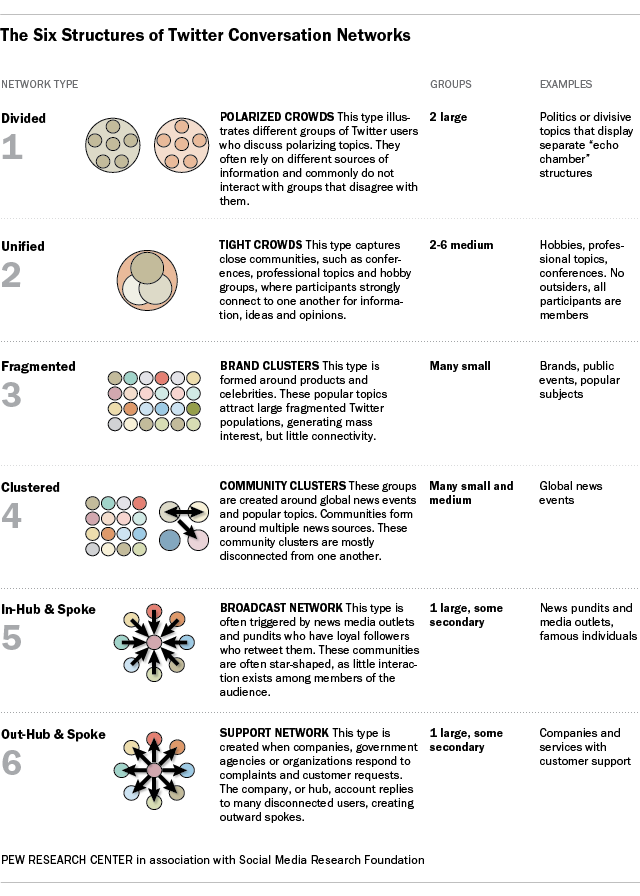
Pew Research have published a new infographic on the “six structures of Twitter conversation networks“.

infographic of Pew's six types of Twitter conversations - link above also has full report

Looking at this, I realised that number 6 – the “out-hub and spoke” shape, a “support network” where the organisation responds to complaints and requests – is how I’d always envisaged a successful library Twitter account to be. Lots of conversations, with lots of users, yay! One of our followers tweets a question about 3D biological models and I can share a link of something I saw mentioned at VALA – it feels pretty good (and apparently made him happy too). —But as the text points out, these are still disconnected users.

What I now think might be a better(*) structure for a library Twitter account is something more like number 2 – the “unified” “tight crowd”. That is, where the library isn’t the centre of the universe, using Twitter as yet another medium in which to guard gates. Instead it’s one member of a group of equal members who all just have conversations with each other.

Fortunately this revelation ties in nicely with my unofficial policy of only following back people who are part of the group(s) we want to be part of. (Staff, students, other departments, local community groups.)

This has paid off pretty well because one such group where I work is actively developing a great wee tight-knit network, and by keeping an ear to that conversation we’ve been able to just slip on in. So they were organising a “Twitter for Academics” session and in preparation one of them asked for top tips to share. I said that what you see on Twitter depends on who you follow. Other people said other things. The library’s not just answering a question: we’re taking part in a conversation (which subsequently got storified).

So if you asked me today my top tip for twittering libraries, I’d say: Don’t just try to start conversations. Also find the conversations that are already happening and join in(**).


(*) Someday I need to blog about “good”, “better” and “best”. Short version, I think the words are actually meaningless unless you’ve answered the questions “Good at doing what?” and/or “Good for who?” Note that I’m not actually answering these questions in this post. Really the best structure depends on what your goal is.

(**) This raises as much as ever the question of “When is this proactive community engagement and when is this creepy stalkerish behaviour?” I think you’re safe if the conversation has a hashtag; pretty safe if there are otherwise a large amorphous group of people discussing something; and likely safe if someone is asking a question to the world at large, but you’re going to have to use your own judgement to figure out if they’re actually intending to ask the world at large or just their friends.

Library as Future #vala14 #p6

Joe Murphy Library as Future

Don’t have a choice in all this – outside world has burned down the way we’ve done things. But can exercise vision in what we build for the future. Also note that the burning is ongoing: change is constant.

Future of libraries will always have to do with inspiration points from the past.
“She who has more curiosity has more strength”.

Do libraries have a future? Well, do we want to engage in the ongoing story of our communities?

Diffusion of creativity in the industry – trend seen in makerspaces, globalisation vs localisation, self-publishing. Use conversation points to inspire.

Identify microprojects that are far-reaching and have tendrils of benefits across the community – library as connector, supporter, future-enabler. Supporting research -> supporting entrepreneurialism.

Internet of Everything
Nest letting you control things in your house (thermostat, lights, etc) with your phone.

Need to face what’s going to be impacting our environment.
Libraries as change entities – open our space to be laboratories, experimental zones.
Libraries as pivot engines – able to make quick turns with new pressures/opportunities
Partnerships as growth – locally with independent publishers and small libraries, with researchers and business, with vendors. And across usage expectations. He recently got a subscription to a print newspaper, not for news, but it’s fun to read this way. Partnering with coders.

New platforms for libraries – smart cars, smart tvs, wearables. Wherever there’s a screen there’s an opportunity for the library because library is still about facilitating access to information. Concept of moving screen from palm of hand in smart phone to somewhere else (wristwatch, google glass…). This stuff is open to developers so the future of these is what you make it.

Libraries as gap filler. Every gap is an opportunity for libraries. Need to harness energy from the tensions of change in our community.

“Now accepting Bitcoin”? [I’m reminded of an article a month or two ago that argued, tongue-in-cheek, that Bitcoin had got a lot more cachet due to its massive crash. Maybe this is true, but it’s kind of disturbing.] Bitcoin ATM in Vancouver actually being used.

Mobile usage continuing to grow and to shift. Messaging had the highest growth – beating out gaming, news, everything. Trends have converged and settle down. A few years ago trend of messaging with pictures and everything included these features. Amazing growth in Snapchat. Opening it opens the camera – photo comes first, caption comes next, last is choosing the audience. Can control how long the photo will exist (10 seconds). Privacy important, as is impermanence and ephemerality. Not saying libraries should use it, but shouldn’t disregard it.

Stop investing in excelling at past strengths. Question about new things is always what old things to give up. We know what we do, we know what we need, we know how we have to appear. There are legitimate important reasons to maintain print collections – for PR if nothing else.

Aereo lets people rent an aerial to watch cable via streaming. (Legal as demonstrated by many many many court cases….)

Gets annoyed at “Netflix for books? that’s a library” – Netflix doesn’t fine people or block people from borrowing.

Library space at SFSW – positioning librarians in the technology space.

Librarians need creativity, curiosity to be change agents. Job description should start “Able and willing to accept change” while directing change.

QR codes didn’t really take off in libraries but we had a good conversation about them – about connecting physical and online content. Will always be a need for a physical point of access to online information.

With new tech shouldn’t ask what’s the point, should ask what opportunities it provides for growth.

Don’t focus on if we have a future or what it is. Focus on how we can get to the future. “Nothing to fear but death and obsolescence.” Books create inspiration, libraries create opportunity.

New workflows and skill sets in Alma #vala14 #s42

Melissa Parent and Lesa Maclean Go with the flow: discovering new workflows and skill sets in Alma

Fully hosted. Not a “library management system” but a “library services platform”. LMSs are built around a catalogue with holdings – description and access for physical resources, not good at dealing with electronic resources. LSP – new info architecture unifying resources management, print and electronic resources and workflows in one place, all systems in one system. [Yebbut I’m still tagging this with LMS though. As described really this just sounds like it’s not a *bad* library management system. I mean, it may do things really really differently it’s still a system that manages library stuff.]

Before Alma had Voyager LMS, SFX link resolver plus central knowledge base, Verde ERMS to do admin work of acquisitions, licenses, trials, relationships between eresources etc. Voyager and SFX tied into Primo discovery layer. Alma (also tied into Primo) unifies resource management – print and eresources together – description, access and management all in one place.

Ebook workflows: under Voyager took 17 steps to get ebooks from ordering to access. Had to edit data in extra steps with MarcEdit; activate in a separate SFX workflow; enter relationships and license associations in Verde. Under Alma it’s 7 steps: data automatically edited with normalisation rules at point of import; ebooks automatically activated in Primo; relationships/license associations automatically created. Idea of automation and human intervention on exceptions only.

Sounds wonderful and is wonderful but complex and powerful and takes time to get used to.

(LMS about managing bib records; Alma about managing actual resource.)

metadata management Institution zone Community zone
populated with eresources that can all share
inventory ebook connected into the institution zone by an “intellectual entity” ebook

By activating something in the Community Zone it pulls it into Primo discovery – but still being managed by Ex Libris, linked to Community Zone intellectual entity. So get a read-only copy of shonky Community Zone record. But can create a local copy of the record and unlink the bad record. Inventory is responsibility of vendor, but associated with our good bibliographic record.

Wonderful but complex for staff. People used to dealing with print-only now dealing with print and electronic. Dealing with both records and inventory, distributed across different layers and different zones. This can lead to confusion about what Alma is and uncertainty about when they see something in Alma is it normal (just new) or is something wrong?

Eg user encountered 7 duplicates on inventory ISBN search but didn’t recognise this as an issue.
Eg user loaded same file twice. Recognised it so went into problem-solving mode and deleted acquisitions info, inventory, bibs – but didn’t recognise that Alma should have just noticed the matches.

Next steps
Innovation requires collective effort – need to get everyone on board. Need more training and orientation. Need to look at the print/electronic division of knowledge – old division of tasks between staff doesn’t work with new technology.

Q: Monash – share your feelings, challenges, ideas. Do you have a feeling of how many records you’re likely to modify from Community Zone and how many to live with?
A: No systematic plan at the moment, just ad hoc. What about at Monash?
Q: Don’t know, probably quite a lot.

Q [me]: Can you feed back modified records to Community Zone for benefit of other libraries?
A: Not yet but Community Zone still in development and working group in place – not sure if they’ll develop in this way though.

Q: Were the changes as big in other teams as for you?
A: Circulation staff had things to sort through.

Q: How does this work with suppliers? Some libraries using suppliers like YBP to activate ebooks. Do you maintain traditional relationships or work on platforms?
A: Never thought of this, discussion hasn’t come up. What’s happening at Adelaide?
Q: Currently go to platform but not sure how it relates to sources like ebrary.