Tag Archives: language

Random XMPPHP note with autobiographical footnote

If you happen, for Sekrit Reasons, to be playing with XMPPHP and you get the error message:

Fatal error: Cannot access protected property XMPPHP_XMPP::$disconnected

What you need to do is go into XMPPHP/XMLStream.php and change line 85 from

protected $disconnected = false;

to

public $disconnected = false;

It’s possible if not likely that people who know more PHP than I(1) could have figured this out for themselves. But I had to quack it, and the only answer was in a Spanish-speaking forum (¡muchos gracias!), so I figured it may be worth putting a translation into the eyes of the search engines for folk who didn’t happen to study Spanish for a few years there.

(1) I went through a stage of learning whatever human languages I could get my hands on, and every few years make an attempt on a new Latin grammar, but I was always most successful when there was a purpose to the learning, like reading novels or translating a Star Trek episode into French or talking to the girl in Mongolia who alerted me to my pocket having just been picked.

When however it comes to computer languages, I’ve never been sufficiently motivated to learn something just for the heck of it, or to embark on a sufficiently gigantic project that my ordinary task-oriented learning methods have accrued much more knowledge than the basics. If I knew more I’d probably use it a little more, but with the kinds of things I tackle, what I know is generally enough to either:

  1. solve the problem;
  2. help me figure out how to quack the problem; or
  3. decide that I didn’t care that much about the problem anyway.

Which I feel is a valid solution, given how many other things there are to do in the world than just code.

Notes from Wales #lianza11 #keynote4

Andrew Green (on Wikipedia) Llyfrgell Genedlaethol Cymru National Library of Wales
Notes from a small country

Small country. Has only smasmodically been its own political entity – mostly dominated by England. One of the first countries to become industrialised. Employment dominated now by public sector and light industry. Welsh and English are the two official languages. Number of Welsh speakers increasing thanks to efforts to develop it as a living medium in school and everyday life.

1997 decision in referendum to move much power from Westminster to Cardiff. Most areas of public policy could be addressed by people directly elected in Wales. Some hoping for full federalism or even full separatism. Currently in period of nation-building.

CyMAL (=a joint eg in the body): Museums Archives and Libraries Wales.
Has helped public libraries upgrade/build new buildings. Encouraged growth of regional consortia. Monitoring standards in Wales. Funded all-Wales catalogue and initiative to give free online access to reference and family research resources in libraries.

But still a steady drain of resources, including professional staff. Trying to get cross-border cooperation.

People’s Collection Wales – Casgliad y Werin Cymru – online showcase of culture. Can log in, upload, create own scrapbook, create a trail or follow a trail, create a map to link in with mobile device.

Principles
Libraries are public goods. Noone should be prevented by lack of means from taking advantage of GLAM institutions. Prefer to deliver digital knowledge for free and without restriction. You can register for no charge and little formality. Can’t always negotiate licenses for as wide access as want, but do the best. When creating/digitising material, insist it’s available for free without charge or need to register.

Keep core services, core permanent staff, then use grants/funding for special projects.

Theatre of Memory project to digitise whole history of Welsh corpus. Want to build an alternative National Library – not bound to physical building which will be inaccessible for many. Will be the largest online corpus to date of material in the Welsh language.

Welsh is a precious asset, needs to be protected by government and people in everyday lives. Libraries play a big role in this. Librarian developed Cyngor Llyfrau Cymru Welsh Books Council. Policy to treat Welsh as equal to English – it’s actually the language mostly spoken within the library so Green mostly uses English only when speaking with users.

Archifau Cymunedol Cymru Community Archives Wales – a project from CultureNet.

Digital Inclusion Wales

Library acts as de facto national archives – only official documents go to National Archives in London.

Report developed: Twenty-twenty: A long view of the National Library of Wales.
Online usage will increase bringing new opportunities and threats. Plateau of people entering buildings; number using it online increasing hugely every month. Digitising will open up collections hugely. Challenge of how to fund without restricting access or losing ownership. Need to move into sound/moving image. Have to address copyright (government may be doing something with orphan works). Interactive library in infancy. Social networking and crowdsourcing currently experimental, will develop to bring library and users together.

Physical library? (Refers to Y Llyfrgell by Fflur Dafyddebook here) Libraries becoming cultural centres. National library has thriving programme. More visitors for cultural use than for reading.

Working with authors to preserve their work in The Welsh Literature Archive Project.

Need to learn how to scrounge, beg, borrow. Also to keep our heads high!

Academic chair in Digital Collections in the national library – may be a first worldwide. Generating project work, fundraising. To do academic work on this but also help national library to maintain and innovate in digital collections. Example of moving forward, not just retrenching. Need to extend existing collaborative initiatives into new areas.

Questions
Q: Digitising up to 1910 – why not further?
A: First digitisation programme was 20th century so ventured straight away into in-copyright material. Second programme wanted to do as much as possible without copyright. Stopped there after taking advice – had to be conservative – left them on safe ground (originally going to stop at 1900). Copyright is 70 years after death of author so even 1910 might be trespassing on copyright. Also issues of trademarks. May need to retreat from that conservatism in future especially if Westminster government changes copyright law especially re orphan works.

Q: Do you have to measure impact re artists-in-residence, and how do you do it?
A: Difficult question, and do get asked it! Don’t offer firm data. Can talk about outputs eg how many kids have been through schemes, but can’t measure imaginative gain on part of children. But plenty of anecdotal and personal evidence from teachers and children of the effect on them.

Q: How do you speak Welsh internally when only 20% of Welsh speak it?
A: Policy is to be bilingual so any job interacting with users staff have to speak both. Not all in library speak Welsh, but definitely those with contact with public. Nothing in charter says this, it’s just something they do and always have done, and people regard library as an organisation that will do this.

Q: Is there an expectation of multiculturalism?
A: Not legally but yes. Not always easy – some of oldest immigrant communities were in Wales. Cardiff had oldest African immigrant population in UK. Not always easy – issues with bringing material away from Cardiff where it belongs – but do have initiatives and have links with communities/organisations.
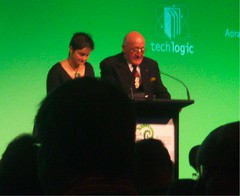
Generation Ngai Tahu

Hana O'Regan and Sir Tipene O'Regan

Sir Tipene O’Regan and Hana O’Regan

The Whare Mahara – The House of Memories

The house is an acknowledgement of the past; embraces the present, providing a place to gather and collect; and is about future as a legacy to be there for the next generation.

Intergenerational transmission of knowledge – will look at tools, systems etc that have been used transmitting knowledge in Ngai Tahu.

Transmitting knowledge also means loss of knowledge. With the arrival of the potato, the whare arohe, the knowledge, poetry, references of fernroot disappeared. With the arrival of iron saws, the time-consuming process of grinding pounamu was lost. The knowledge of those who lost wars – their poems and stories – is gone. “History always forgets the losers.” — Tā Tipene

Hana says she and her father have very different perspectives. (Her father interrupts to correct “focuses” to “foci”. 🙂 ) Each generation influenced by events and values of their time. Tipene says older generation may have longer view.

Hana defends “she waits for the movie to come out” by pointing out that it’s higher quality than old reels, and in colour, and she has access to a wider range of technologies than older generations had.

Tipene’s father had benefit of his father’s library; his uncle read Gibbons’ Decline and Fall 20 or so times and also a fisherman, but belonged to “an aristocracy of knowledge”. Tipene was exposed to Dickens before he read it as father read it to him when a child. Father: “What’s the use of Latin? None, thank God. Lord preserve us from the tyranny of relevance!” Tipene: “We all handle knowledge differently.”

Structural questions: – selection, determining what we want to know and preserve; loss – do we want to lose it and not-know just because we’re no longer using it.

Pre-European

  • Priorities: maintaining tribal boundaries, survival, whakapapa, mahinga kai
  • Tools: mōteatea, karakia, kōrero o nehe, pūrākau, whakairo

Early settlement

  • Priorities: adaptation (fish hooks and axes, steel replaced stone), globalised knowledge, new worldviews and worlds (sealskins going to China and Māori travelling in those ships), new commerce/production
  • the written word, books, Christianity

Post Ngāi Tahu Deeds/Treaty

  • Priorities: survival, diseases, introduction of an abstract legal code, retaining land, economic sustainability
  • Tools – petitions, letters, presentations to commissioners

Ngāi Tahu Claim

  • Priorities: documenting the Middle Island land claims and securing fulfilment of South Island Purchase contracts
  • Tools: private journals, whakapapa records, manuscripts, petitions, legal documents

Waitangi Tribunal

  • Priorities: collection of information to prove traditional use rights and mana whenua, establishing the tribal base, political organisation, economic sustainability
  • Tools: secondary and primary research, records of oral traditions, oral accounts of sustained practices and traditions, specialist analysis of mahika kai resources

Ngāi Tahu settlement

  • Priorities: commercial viability, maintaining tribal boundaries, understanding development, redevelopment of tribal resources, moving from claim-mode to looking to future
  • Tools: radio, tv, digital media, websites, print, books, magazines (Te Karaka, Te Panui Runaka) – new tools but still missing something.

Move away from process of repetition to transmit knowledge – can now be recorded and stored and retrieved in other ways – print and video. Don’t have to retain knowledge as parents and grandparents did – can Google it.

Knowledge as entertainment – takes it back to the fireside.

Te Reo as an example – language was neglected for a long time. Why did so many generations raised in the language not transmit it to their children? Sir Apirana Ngata argued that the first priorities of education for Māori should be English, English, English. They felt that the community spoke Māori and it couldn’t possibly be lost, so focused on English. This happened to Gaelic in Ireland too, and elsewhere. Hindsight is 20/20….

Languages (47% endangered, threatened or extinct) are far more threatened than birds (11%), mammals (18%), fish (5%), plants (8%). Particularly low statistics of Ngāi Tahu language proficiency among Ngāi Tahu speakers. Hana’s frustrated that language doesn’t feature on the tribal wish-list; Tipene interrupts to say it features on the wish-list all the time – just not on the “must do” list. It’s a systemic problem: you can’t understand place names unless you have Te Reo.

Hana comments on the “PC-ing” of knowledge that is being transmitted. Lullabies used to include quite graphic depictions of past wars and necessary revenge – what it might look like (“or taste like”). Now sanitising a whole body of knowledge by omitting this.

How will Ngāi Tahu decide what knowledge to transmit to their mokopuna? What will they need to know to be Ngāi Tahu, to survive, and prosper? What songs will they sing?

Call back to conference theme – He aha te mea nui o te ao? He tāngata, he tāngata, he tāngata. (What’s the most important thing in the world? It’s people, people, people.)