From "We Shall Remain" to "Operation teen book drop"

new national indigenous library services initiatives
Loriene Roy and Scott Smith
abstract (pdf); We Shall Remain librarians’ website

Once American Indians were the whole of the now-USA population; now 0.1%.
Urban/homeland split due to 1950s/60s policy of relocation. Health, higher education, economics, traditions are compromised.

Initiatives to support libraries; this presentation is a status on these two projects.

“We Shall Remain”
Film is a rich media to show experience. Indigenous have been depicted in film for decades but are rarely involved in the production itself. “We Shall Remain” is a PBS show, the largest “American Experience” series produced. Aired in 5 90-minute episodes: After the Mayflower (depicting especially Wampanoag, Pequot, Nipmuc, Narragansett), Tecumseh’s Vision (Shawnee), Trail of Tears (Cherokee), Geronimo (Chiricahua Apache), Wounded Knee (Oglala Lakota and Native peoples from tribes across the country). The last was able to draw on rich media coverage from the time.

Project also included a mentoring programme for Native film producers, and a website linked to many films created. Grants for states and cities to collaborate with local organisations to create public events, programming and to deepen public understanding of Native history.

Event kit for libraries gives ideas about how to organise culturally appropriate discussions. Storytelling events, reading circle (“The Plague of Doves”), exploring stereotypes, art contests and projects, discussion forums, film festival, guideleines for evaluating media resources (many preexisting guides for selecting books on Native topics; this is the first for evaluating film) – shipped to 15,000 public libraries. Won an award for design and communication. PDF copy available at We Shall Remain librarians’ website. Two Facebook groups.

The “We Shall Remain” title image of the teepee and flag (“Nespelem”, a photo by Bob Charlo of the Kalispel Nation, was taken at the annual powow on the Colville Reservation in Nespelem, WA in 1992): “To me it represents that we – Native people – are still here and still vibrant. We are not a conquered people. We are a contributing people.” — Bob Charlo

Highest number of states with events were Arizona, Texas, and Utah. Most popular were lectures/discussions (often about topics re the TV programmes), screenings (of previews or episodes (esp Trail of Tears) or local films by Native producers/authors, displays of books/photographs/other featuring Native history and/or authors, sometimes collaborating with local organisations); then performance and hands-on activities (weaving, basketry, games, musical and dramatic performances, crocheting afghans donated to local hospital).

Operation Teen Book Drop
Donation of 8,000 YA books to hospitalised teens in 2008-09 by publishers, organised by readergirlz, Guys Lit Wire, and YALSA. April 15th 2010 will take YA books to teens attending tribal schools on reservations. So far 27 schools registered – about 5000 teens. Featuring Lurline Waliana McGregor, Sherman Alexie, Joseph Bushac (sp?) – other names mentioned include Dean Koontz.

Coordinating national publicity plan to tribal newsletters and library community.

Will have live chat at readergirlz.com. Raising funds online.

Successes are result of collaboration, promotion, and planning.

Q: Why would schools not want to be involved?
A: Might have assumed would get a different title per student – instead it’s one title for the whole community so they might feel it’s too much work for a single title. Another issue is that publishers are saying “Take the books now” so storage space is an issue. Trying to locate local liaisons to help with work.

Q: Will it screen in New Zealand?
A: Needs to be picked up by tv; but can buy on PBS.
Libraries building communities: communities building libraries

Jessica Dorr
abstract (pdf)

Begins with “Kia ora”; ends with “Kia ora koutou”. 🙂

Says our reputation precedes us.

Bill & Melinda Gates Foundation guided by belief that every life has equal value. Goals to improve health; strengthen education; reduce poverty. “Bill Gates has billions of dollars. Why would he give it to libraries? The answer is simple: libraries change lives.” Librarians work to make information available -> strong drivers of economic and social progress.

Project to connect all libraries to the internet within five years. Spirit similar to APNK but didn’t know how challenging task (including technical support) would be. Pulled it off though it took closer to seven years. Total PCs granted = 47,200; buildings receiving a grant: 10,915; training opportunities: 62,000. When started, less than a quarter had access to internet; now all do, and provide it for free. “If you can reach a public library, you can reach the internet.”

Started with poorer libraries – those not already connected. Started with states in highest need — Deep South. New Mexico was sixth state and provided challenges and opportunities. First large state they worked in. Noticed when plotted a map there were large gaps with no libraries – discovered those were tribal reservation areas. Felt it was unfathomable that there was no need so went to visit. Found lots of space, and found libraries which weren’t on the state-recognised list of libraries.

Underestimated challenges of technology and underestimated the relevance of the internet to these communities. Showed Microsoft Encarta online encyclopaedia and they searched for themselves. Found mistakes in the encyclopaedia.

Began a crash course – couldn’t just add libraries to a list of libraries and give them computers. Needed to do more. Used loom as analogy: if weaving this project needed to learn all six steps.

(Native communities are justifiably wary of the outside world but want education, want to learn to use computers in a native way.)

Find a sheep / Shearing / Needs assessment
Environment makes providing services more difficult and expensive.
Computers have to speak and write Native languages
Could work with tribes and network – worked hard to involve all of Navaho
Had to work with Navaho definition of library
Had to build capacity and support organisations that work with tribes long-term
Tools/equipment: scanners, microphones, digital cameras, software tools, test models, drove computers and generators out to test them thoroughly.

Wash and dye / Training
Project-based – using Native examples
Presenting information less linear, more circular/interrelated
Short days as people had to leave early to chop wood, etc
Mornings teaching staff, afternoons outreach (students, tribal elders, police, any group that had interest in training)

Card and spin / Program challenges
Connectivity – In US program didn’t plan for long-term payment because government should provide. But here couldn’t expect to persuade tribal governments to pay, so gave step-down funding (more first year, less next, less next) to give tribal governments time to recognise the value outweighed disadvantages like porn.
Challenge in staff turnover so training need never goes away

Dye and pattern / Examples of success
Indigenous Language Institute uses YouTube to promote preservation of native langauges
Websites developed for/by government of all chapters so can email instead of drive, minutes and budgets are online. Bartering online.
Individuals – computer lets people do homework online instead of driving hours to study.

With the tools in place, they are weaving.

Learned importance of being familiar with community needs and working with them.

Now working in other countries. Aim to bring about effective, sustainable access in developing countries. Want computers to be useful and used in ways to improve lives.

Need training for staff – both in technology and outreach
Libraries have to be accessible and open to all. Might need to include health clinic; or be on a boat.
Libraries have to demonstrate impact by measuring how they meet local needs

In terms of sustainability, suffering because assumed benefits of libraries were obvious so didn’t spend effort on evaluation so libraries could prove benefits. Now work from beginning to include an evaluation component. In Latvia compare library services across other government services. In Lithuania doing a study showing return on investment. In Poland doing a study of library users vs non-users. –Different from country to country but critical to have some evaluation in place.

Need strong library systems in place to provide vision for field, develop curricula, create sharing opportunities.

More than 70% of people in US who use computers in a library say it’s the only place they have internet access.

Latvia had so many people sitting outside after hours to use wireless that used bandwidth stats to argue for longer open hours.

Libraries need to radically change perceptions people have about libraries, we won’t survive. Have to be bold, be more radical, be louder, use data, use stories. Must champion and strengthen the resource. Need to keep libraries on the agenda.

Story of mayor in Latvia who had to decide whether to improve roads or libraries. Decided to invest in library – and discovered ripple effect on local business, kids staying in school longer.

Q: Even with full funding, would be difficulties in some public libraries to add internet. How did you manage that?
A: There’s no national library in the US – just state libraries. So asked state libraries to apply on behalf of their libraries. Because it was the Gates Foundation, states didn’t want to be left out. Some were hesitant, but starting in places with most need showed their priorities. Policy to only work in libraries that would provide free internet. Some libraries didn’t want to, but the momentum carried it through.

Q: How are you involved in prison libraries?
A: Haven’t been yet. Have also been asked about academic, schools. But have chosen to invest in public libraries.

Q: How are libraries sustaining themselves in difficult economic times.
A: Difficult. 20-25% of libraries are at forefront and can continually refresh computers. Middle group, and then 40% really struggle and in 5 years haven’t been able to upgrade. So studying what’s the difference between these groups? High-performing libraries isn’t due to funding as much as due to the librarian – if they’re actively involved, actively promoting, they perform well. So future training is focusing in this area too.

Q: Has foundation work increased opportunity for collaboration between libraries?
A: She thinks so, and they’re trying to support it. Spend time building partnerships between grantees; support them to conferences, publication, etc. Recommends looking at their website.

Q: Could the Foundation look at supporting indigenous [libraries?] all around the world to get together?
A: Good idea – will take that back and consider it.

Q: [missed it]
A: Every State Library has a different mandate, governance structure, statutes, etc. Some State Libraries didn’t even know how many libraries they have. Some have state conferences, some might barely send out an annual newsletter. Would have liked to spend more time working with state libraries but weren’t comfortable meddling into policy issues.

Q: Is meeting Rodney Hide and will show movie re Latvian mayor. Hoping to gather more stories re value politicians place on libraries.

A new equity emerges

citizen-created content powering the knowledge economy
Penny Carnaby
abstract (pdf)

Just when we thought we had the web2 environment sussed, it’s about to get more exciting for librarians world-wide. A new equity is emerging which puts individual citizens in the driving seat for the first time.

Every day someone is deleting something on the web. We’re all part of the delete generation. Hana and Sir Tipene O’Regan talked about the loss of indigenous languages.

As librarians we need to take responsibility for preserving information.

Building blocks
Roll-out of broadband
National Digital Heritage Archive
Aotearoa People’s Network Kaharoa
Digital New Zealand
data and information reuse
NLNZ New Generation Strategy

New government has endorsed the digital content strategy. Talks about life of asset from creation to access to sharing to managing and preserving.

Information on two axes from private public and from formal informal.

National Digital Heritage Archive. If we’re taking citizen-created content as seriously as formally created content, how do we go about preserving it? What do we curate – porn, hate sites too?

DigitalNZ has put over 1million NZ digital assets online in one year.

Aotearoa People’s Network Kaharoa – cornerstone of allowing citizen-created content. Allows local kete to emerge all over, through libraries and marae. Extraordinary emergence of citizen-created information collections.

Idea of creating a virtual learning environment in every school, founded on govt-supplied broadband. Ministry of Education looking at how APNK works and thinking about how that could work if it was in every New Zealand school. (Me: Whee!)

International colleagues see New Zealand as an “incubator country”.

Announcement: Will be digitising the Appendices to the Journals of the House of Representatives. (Me: Whee again! This has been much-requested and will be a very valuable asset.)

As of February this year, with digital heritage archive, “we refuse to be part of the delete generation”.

New equity emerging. Kiwis from all walks of life creating solutions to harness and preserve. Each of us has contributed to New Zealand emerging as a digital democracy.

What would you do?

Developing and sharing creative solutions (aka Doing More With Less)
Elizabeth Whyte, Paul Sutherland
“90 minutes of user-generated discussion. In the spirit of Unconference and Pecha Kucha, hear rapid-fire presentations of ideas and challenges from your colleagues. Then break into groups, design solutions, and get inspired to do more with less.”

Going to watch presentations, ask questions without answering, and then break into groups (“of at least two people because otherwise it wouldn’t be a group”) to generate answers.

I started with my suggestion box presentation, which I’ll upload later. (ETA: it’s here.) Questions about this were:
– How responded to allegation that AU is better than CU?
– How are questions and answers distributed?
– Staff training for social media sites
– Should we forego paper suggestion boxes completely?
Break-out groups came up with: (ETA – there was much more discussion that I’ve noted of course! These only include the ‘takeaway’ summary reported back at the end of the session.)
– If people ask a question/complain, respond in public so everyone can see.

We got another presentation on “What would you do about disruptive youth in a public library?” This library is the only free sheltered space in the area. So kids will congregate which is great, but some associated behaviour (especially age 9-14) is less than delightful. Verbal abuse of staff, customers; bullying; assault; gang activity. Long-term they want kids to stay in the library and keep reading. Diagnose much activity as boredom. Are having holiday programs. Want low-key, low-cost, low-advertising, low-efforts. Have used trespass orders but a 2-year tresspass order to an 11-year old is icky. Police relationship, contacts with schools and other agencies. Blogging on an internal incident archive. Training staff. What else can be done?
Questions from the audience:
– How do older kids respond to incidents?
– Does library employ extra staff in holidays?
– What’s the scope of the youth worker role?
– What about ways of getting youth to interact with library knowledge other than passive reading?
– Can you create an alternative space?
– How do you engage with parents of children?
– What are their interests?
Break-out groups came up with:
– It’s good that youth are coming in; they’re disconnected and libraries are connecting them into society.
– Lots of other ideas and going to work it into something coherent.

Jack Goodman
Libraries have lots of fans but not necessarily outspoken ones. Library is the cool place to hang out because we’re about people. Talks about building relationships with businesses, universities, polytechs, future generations of educators. Sporting clubs. WIIFM? What’s in it for me/libraries? Innovation is essential. Normally takes a lot of resources, money. Denmark $122 per capita funding for libraries; NZ ~$60, Aus ~40.
Have we thought about partnerships with local gardening centre? Example of garden centre referring to library for care instructions.
Questions from the audience:
– Can you get a supplier to support a project within the library?
– How would you make the first approach?
– Have you done this yourself?
Break-out groups came up with:
– Libraries shouldn’t sell themselves short re potential partnerships. Build relationships.

Ellen Thompson from Queensland University of Technology on the unconference “It functions better when more traditional meetings fail.” Traditional meeting boring – either nod off or get surly and disruptive. Would like more dynamic ideas movement going on in meetings. Wants an un-meeting. So did it – convinced boss to have a fortnightly agenda meeting and every second week have an un-meeting:

  • whoever comes is the right people
  • whatever they talk about is the right topic
  • when it starts it’s right, when it’s over it’s over
  • law of two feet

To get a quick meeting: have it standing up. (Audience suggestion to secretly take the chairs away.) Are there any systems, practices, procedures in our organisation that we can “un-“?
– un-performance and strategic direction
– un-jargon
– joking: un-reference interview
– un-email (talk to colleagues instead)
– un-bureaucracy
– un-heirarchy of information and power
– un-serious
– un-noncontroversial
(Put the “un” in “fun”!)
– un-risk averse
– ungry!
Break-out groups came up with:
– A well-run meeting can be a beautiful thing.
– Need to have purpose and time and place.
– Don’t try to mash-up agenda-meeting and unmeeting – will get the worst of both worlds.
– Some people have standup meetings and they work, so it can be done!

Claire Stent from Statistics New Zealand
We try to offer the silver service “everything to everyone all the time”. But then people are in the food court! They know Google’s not the best search tool but it’s quick and easy and has no tutting librarian over their shoulder. They don’t feel *comfortable* with our portals. So what do we do? We improve our portals and our processes. So it’s not silver service any more, but there’s still no people because nothing’s changed: the same service is still under the hood. Uni students get a course reader – a chapter here and a journal article there.
What do we want? Something different, like a picnic or barbecue? Why be a restaurant if people don’t want that? So now if people go to their research page they get training, emails, etc to do with research. Also has pictures! Getting lots of good feedback.
People don’t want journals and issues; they want one subject-related article. So instead of table of contents, get a subject-related alert. RSS feed search alerts from Ebsco or ProQuest.
Don’t invent your same service in a new way; invent a new service!
Questions from audience:
– Why second-guess what people want rather than asking them? (or watching what they use)
– Do your staff understand alerts and RSS feeds?
– Is the value of libraries in the food or the service or the menu?
Break-out groups came up with:
– Vote that we’re about service.
– We’re not convinced people know what they want. Should observe them rather than ask.
– People like different delivery methods – need to do a variety of things.


LIANZA Ning – if people sign up we can write up what we came up with today.

The role of libraries in emerging models of scholarly communication

a faculty-library publishing partnership
Sigi Jöttkandt, John Willinsky, Shana Kimball
abstract (pdf)

Crisis in scholarly publishing
Exponential rise in subscription prices, decline in library budgets, consolidation of the publishing industry. Affects everyone in academia but especially the “book disciplines” eg humanities. Crisis for readers (access to scholarly materials decreases) and for authors (fewer publishers to be published by).

Open access as a response
Definition by Peter Suber.

Alternative publication models
“Green road” – institutional repositories freely available. Discipline-specific eg arXiv.org, CSeARCH.

“Gold Road” – open access publishing – Directory of Open Access Journals

Open Humanities Press
Slow uptake of OA among humanities scholars, perhaps because of perceptions among humanities researchers that internet isn’t an appropriate publishing/researching venue. Open Humanities Press founded to counter these perceptions. Primary importance for humanities is not time to publication but prestige. Author-side fees would be inappropriate and didn’t want to waste time fundraising, so instead of starting new journals, looked to gather pre-existing efforts.

Launched Open Humanities Press with seven journals. Aim to raise profile and credibility of these journals. Assess journals according to various policies
Libraries Scholarly Publishing Office. Use open source publishing software.

Found there was a perception that OHP would soon be involved in books so ran with it. Formed a model where international scholars get together to edit, peer-review, and publish books – eventually e-publishing. Aim to double publishing of books each year.

Hope model will take off more widely. Doesn’t require much change from academics.

Still a community/volunteer project.

Public Knowledge Project
Open journal systems, open conference systems, developing open monograph systems

Made a dummy OA “LIANZA Journal” and Sigi says she’d be happy to talk to people about actually making the journal open access!

They’re modularising the journal system to create a software platform for a monograph system.

Q: Would publishers use this system to set up open access monographs? What’s the role of the library?
A: Scholarly Publishing Office is just for the conversion side of things – academics still do editing and peer review. Would like to see more libraries offer these services to scholars.

Q: Who does subject headings – authors or SPO?
A: Authors do add keywords. Journals are catalogued by libraries so subject headings are added there too.

Here, there and virtually everywhere

library services for distance learners
Anne Ferrier-Watson
abstract (pdf)

[Argh, network cut out in this room.]

History of Virtual Education Reference Desk (VERD)
1997 – BTeaching started distance services
2000 – need to streamline processes so VERD was created
2008(?) – Moodle has taken VERD to a new level

Philosophy to “give students the fishing line, not the fish”
Over 3000 education students are enrolled in online papers

1.75 EFTS supporting VERD. Busier at some times than others.

Asynchronous service – answering Monday to Friday. Many questions asked have been answered before so they’ve got an ongoing work in progress of making previous answers easy to find

5 sections:

  • Request items or information (can fill out a webmail form or ask for help on forums – 7500 views in the last 12 months)
  • Library FAQs (started as answers to easy common queries; now starting to use it for standard answers for more complex questions too)
  • Help with APA referencing (“our favourite section” – laughter – 2500 views in semester B – a few pdf guides and a link to the forums too)
  • Catalogue guides (not high use – many just use it for the link to the library catalogue; starting to think of putting in video tutorials)
  • Guide to finding journal articles (high use – includes videos for using ebsco, proquest, indexNZ; also pdf guides to various databases)

Jing screen capture software – easy to use, free-as-in-beer but not open source.

Feedback from students includes:
“The video instruction is fantastic too as I find it easier to do something if I see it in action.”
“now if I forget a step I can use [the online tutorials] to find the right path again”
“you are like the referencing angel”

Can look at individual activity reports so when someone asks a question you can see where they’ve already looked for help.

Can look at overall activity reports to give an idea of where most activity is happening and most work is best spent.

Q: What’s providing the format?
A: Working around the Moodle format. Not actually a fan about the format but it’s the best they can do.
Suggestion: Worked with McGovern to create ManyAnswers.co.nz which can be put on your own website. (Me: ? Not sure whether she meant the whole manyanswers service or the platform to support your own FAQ.)

Q: Forums available to all students or just distance?
A: Available to those enrolled in those papers.

Q: Are guides available on public site or just private forums?
A: Some static guides (not interactive) are available on the public website. Looking at redeveloping some of this too.

Q: re answering repeat questions
A: Some refer back to previous answers, some move them into FAQs and refer there.

Libraries on the agenda

Claudia Lux

Kris Wehipeihana is covering this better than me. A few highlights:

www.ifla.org has a Success Stories section which she asks NZ libraries to add to as it’s important for their advocacy functions. Success stories show how libraries develop and support the information society. They help networking and partnering; show the value of libraries; help you measure the impact your work has for a student, teacher, administrator….

Transparency – what is a librarian doing all day? Do our users know? Can we explain it? Do we explain it?

Libraries aren’t visible to city planners. Need to explain what we do, advocate. Start marketing

  • no complaints – don’t go up to the minister saying “My library leaks and no-one’s coming and I need more money and more space!” – just puts off the minister. Instead try “I read your speech, it was great, and even though you don’t know it, it has a lot to do with libraries, I’d love to talk about how we can support your work.” Next time s/he remembers your name and that you’re a nice person. 🙂
  • good news “Great news! We’ve got so many people coming into the library that there’s no room for them all to sit down!”
  • surprise your customer
  • define successful methods
  • present your normal work differently

Use success stories and pictures to convince your politician. One picture, or a short video, says more about your activity than a long report, and sticks in their mind better. (NB politicians love children so lots of pictures of children. Young adults are harder…)

What can you do?

  • shape the picture
  • collect arguments
  • know developments in advance
  • connect to the library association
  • help analyse possibilities
  • show best practice
  • make demands
  • never stop

Successful advocacy needs training and is ongoing.

Q: Is it time to update the public libraries manifesto?
A: yes

Q: re what steps we could take to support indigenous / tangata whenua (question was more involved/specific but I lost part of it)
A: Claudia promises to bring this to the governing board at IFLA. Applause from the audience.

Q: Why be involved in IFLA – how would home community benefit?
A: If you don’t contribute who will? We’re privileged speaking English so easier to have influence. (Three very active NZ chairs already. We’re “small and smart”.) Bringing many ideas, big and small, back to your library. And shows you and your library how well you’re really doing.

Making IT work for you

Warwick Grey and Corin Haines
Warwick from HP – never set out to do IT but fell into it.

Tech trends 2009

  • netbook adoption accelerates
  • built-in wireless broadband usage widens
  • cell phones get more software

  • unified communications increase
  • online data backups proliferate
  • social media becomes strategic at home and in business
  • online video gets cheaper and there’s more of it
  • video conference solutions expand
  • hosted software applications
  • online presence gap widens as more customers use online search before they buy

“My young life was in black and white and nothing was what I chose to watch.”
1970 calculator
1971 microprocessor
1974 colour television
1989 world of DOS
2008-2030 pervasive computing environment

Instead of building infrastructure should build community
create content -> create loyalty
enable transactions -> enable self-service
capture eyeballs -> capture experts
integrating applications -> integrating channels

Launching new fashion laptops – colours and imprinted designs

Increasingly looking at sharing information with many people at once instead of one-on-one email, video conferencing.

Cloud services = shared under virtualised management accessible over the internet
Social networking = staying connected with more people in more places

Corin:
People marketing business on Twitter – fast growing network.
Demonstrates a video recorded yesterday on a Flip camera and uploaded to YouTube
Demonstrates mash-up he made of out-of-copyright music from World War I with photos National Library uploaded to Flickr Commons

Warwick
Skype has been released for phones
Should be putting RSS options into news we provide
Bookmarking and sharing – even bookabach gives you 55 options to bookmark their pages
Mashup with Google Maps lets you show where you’ve run
Have a facebook site for your library!

Touch-screens are getting big – demonstrates touch notebook moving things on screen, magnifying video, etc – “Windows 7 is like Vista without the brain cancer”

Video showing touch-screen possibilities – fingerpainting on screen, putting together a jigsaw puzzle with a moving image, put camera on touch screen and photos appear wirelessly on the screen.

(NB I’ve left out most of the plugs for HP-specific technology 🙂

Shows Windows Movie Maker – looks fairly similar to iMovie.

Engage customrs where conversations/activity is already taking place
Empower your internal advocates (HP measures who’s most positive in their twittering about HP)
Accelerate and efforts across your organisation

Message from the Minister / LIANZA Awards

Starting with a message from Nicky Wagner MP, speaking on behalf of the Minister responsible for National Library and Archives NZ, Nathan Guy. (He’s in a budget meeting today.) Library has signficant contribution to make socially, economically, etc, to country’s wellbeing. Driving goal of this govt is to grow the economy. Recognise difficult financial times.

Rollout of ultra-fast broadband network throughout NZ. Improving schools and frontline services to public. Need to lift educational standards. Focus on literacy and numeracy.

Another key driver is innovation including research.

Services we provide are important to society; the public expects more and more. Glad that our profession is addressing questions of services vs technology. National Library is a leading centre in preserving documentary heritage of New Zealand. Minister is keen to see more people engaging with collections housed there.

So much depends on easy access to information. Libraries make quality NZ information accessible. National Library has done groundbreaking work. Demonstrates value of cross-govt, cross-sector collaboration. Collaboration within library profession makes a lot of sense in these difficult times. APNK and EPIC are great examples.

[Pronounces LIANZA as L.I.A.N.Z.A.]

Believes librarians are very much at the front line of research, engendering a love of reading, developing new innovation.

Need more integration so NZ data is available to those who need it. Need more collaboration for efficiency and to be active at national level. Need to think carefully how sector as a whole can grow from here.

Warm up comedy act by “Pedro Haust” and “Pia Haust” collectively making up “The Hausts” (pronounced “The Hosts”) with fake Spanish accents. Um. Well, Everyone Knows(TM) that foreign accents are inherently funny, right, because they’re spoken by foreigners; but I’d at least have left out the jokes about Tourette’s Syndrome and bulimics. — And I would like to hope that the final joke aimed at Barbara Garriock was done with her foreknowledge and consent.

LIANZA awards
2009 LIANZA Award Recipients

Rua Mano Award
Ariana Tikao

John Harris Award
Mary Ronnie for Freedom to Read
Moira Fraser for Parliametary Library 150 Years

Crown Records Management Scholarship
Anderina McLean
Adrian Jenkins

YBP/Lindsay and Croft Award for Collection Services
Margaret Ferguson

Nielsen Bookdata Research Award
Paula Legel & Kris Wehipeihana

MLIS Annual Research Prize
Highly Commended Award
[Missed the two names as we had no slides]

3M Award (see my earlier post)
3rd – Auckland City Libraries for Active Movement
2nd – Nelson District Libraries for Top of the South
1st – National Library/Marlborough District Library for Aotearoa People’s Network Kaharoa

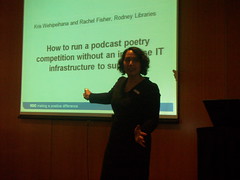
How to run a podcast poetry competition

Kris Wehipeihana - How to run a podcast poetry competition

without an in-house IT infrastructure to support it
Rachel Fisher, Kris Wehipeihana
abstract (pdf)

Covering podcasting; working outside IT infrastructure; social media.

Using Blogger, Twitter, Google Calendar. But if your team isn’t keen it won’t happen.

Linking Montana Poetry Day activities to something that could be pushed out through to school activities. Wrote it quickly.

Clause 4 of terms and conditions – that poems are shared under Creative Commons BY-NC-ND. No questions or complaints from users.

Didn’t have any speaker/microphone/sound cards/file space at all. Most work done on Rachel’s own time and own computer. Used free software. Some shortcomings but advantages outweighed disadvantages.

Blogger as easy to use. Free templates can be customised but not easy if you’re not familiar with html. However there’s lots of instructions available online especially as Blogger is so popular.

Audacity – all you need to know is the location of record, stop, pause, play. Advanced functionality available if you’re technically minded. Save-to-mp3 is an extra file so awkward step for users. Comes included in APNK package.

File hosting – two downsides include: sites require you to sign in regularly or you’ll lose your account. Can also impose file storage and file size limits (but probably not a problem unless your competition is really popular).

Stat counters (eg StatCounter) lets you know how many people are visiting, whether they’re repeat visitors, where they come from again. Google Analytics is another one they use and will use in future.

Last year people could only enter if they had their own equipment; now they have stuff through APNK it’s opened things up for everyone. APNK should be self-managing but customers still ask librarians for help, so librarians require training.

Rodney Libraries uses a yahoo email address because their staff email has size limits – it also ties in with their Flickr account.

File hosting sponsor this year is Liquid Silver.

Ideal set up would have dedicated website where customers can fill in mandatory information and upload files directly. Computers would have all equipment and software preloaded; staff would be fully trained. Significant relationships with local schools to combine curriculum areas (technology, english, etc). One school in Rodney catchment area has more classes participating each year.

Intends to maintain presence in web2 sites so as to be in a good position when demand for these services increases.

First year had 32 entries; second year 56. (50 entries in short story competition, for comparison.)

Tim Spalding asked whether they’ve looked at sites where people can post poems and have them critiqued.

Some difficulties in first year of competition re dialup – but it could be done, so don’t let dialup be your excuse not to do it!