Monthly Archives: October 2009

The role of libraries in emerging models of scholarly communication

a faculty-library publishing partnership
Sigi Jöttkandt, John Willinsky, Shana Kimball
abstract (pdf)

Crisis in scholarly publishing
Exponential rise in subscription prices, decline in library budgets, consolidation of the publishing industry. Affects everyone in academia but especially the “book disciplines” eg humanities. Crisis for readers (access to scholarly materials decreases) and for authors (fewer publishers to be published by).

Open access as a response
Definition by Peter Suber.

Alternative publication models
“Green road” – institutional repositories freely available. Discipline-specific eg arXiv.org, CSeARCH.

“Gold Road” – open access publishing – Directory of Open Access Journals

Open Humanities Press
Slow uptake of OA among humanities scholars, perhaps because of perceptions among humanities researchers that internet isn’t an appropriate publishing/researching venue. Open Humanities Press founded to counter these perceptions. Primary importance for humanities is not time to publication but prestige. Author-side fees would be inappropriate and didn’t want to waste time fundraising, so instead of starting new journals, looked to gather pre-existing efforts.

Launched Open Humanities Press with seven journals. Aim to raise profile and credibility of these journals. Assess journals according to various policies
Libraries Scholarly Publishing Office. Use open source publishing software.

Found there was a perception that OHP would soon be involved in books so ran with it. Formed a model where international scholars get together to edit, peer-review, and publish books – eventually e-publishing. Aim to double publishing of books each year.

Hope model will take off more widely. Doesn’t require much change from academics.

Still a community/volunteer project.

Public Knowledge Project
Open journal systems, open conference systems, developing open monograph systems

Made a dummy OA “LIANZA Journal” and Sigi says she’d be happy to talk to people about actually making the journal open access!

They’re modularising the journal system to create a software platform for a monograph system.

Q: Would publishers use this system to set up open access monographs? What’s the role of the library?
A: Scholarly Publishing Office is just for the conversion side of things – academics still do editing and peer review. Would like to see more libraries offer these services to scholars.

Q: Who does subject headings – authors or SPO?
A: Authors do add keywords. Journals are catalogued by libraries so subject headings are added there too.

Here, there and virtually everywhere

library services for distance learners
Anne Ferrier-Watson
abstract (pdf)

[Argh, network cut out in this room.]

History of Virtual Education Reference Desk (VERD)
1997 – BTeaching started distance services
2000 – need to streamline processes so VERD was created
2008(?) – Moodle has taken VERD to a new level

Philosophy to “give students the fishing line, not the fish”
Over 3000 education students are enrolled in online papers

1.75 EFTS supporting VERD. Busier at some times than others.

Asynchronous service – answering Monday to Friday. Many questions asked have been answered before so they’ve got an ongoing work in progress of making previous answers easy to find

5 sections:

  • Request items or information (can fill out a webmail form or ask for help on forums – 7500 views in the last 12 months)
  • Library FAQs (started as answers to easy common queries; now starting to use it for standard answers for more complex questions too)
  • Help with APA referencing (“our favourite section” – laughter – 2500 views in semester B – a few pdf guides and a link to the forums too)
  • Catalogue guides (not high use – many just use it for the link to the library catalogue; starting to think of putting in video tutorials)
  • Guide to finding journal articles (high use – includes videos for using ebsco, proquest, indexNZ; also pdf guides to various databases)

Jing screen capture software – easy to use, free-as-in-beer but not open source.

Feedback from students includes:
“The video instruction is fantastic too as I find it easier to do something if I see it in action.”
“now if I forget a step I can use [the online tutorials] to find the right path again”
“you are like the referencing angel”

Can look at individual activity reports so when someone asks a question you can see where they’ve already looked for help.

Can look at overall activity reports to give an idea of where most activity is happening and most work is best spent.

Q: What’s providing the format?
A: Working around the Moodle format. Not actually a fan about the format but it’s the best they can do.
Suggestion: Worked with McGovern to create ManyAnswers.co.nz which can be put on your own website. (Me: ? Not sure whether she meant the whole manyanswers service or the platform to support your own FAQ.)

Q: Forums available to all students or just distance?
A: Available to those enrolled in those papers.

Q: Are guides available on public site or just private forums?
A: Some static guides (not interactive) are available on the public website. Looking at redeveloping some of this too.

Q: re answering repeat questions
A: Some refer back to previous answers, some move them into FAQs and refer there.

Libraries on the agenda

Claudia Lux

Kris Wehipeihana is covering this better than me. A few highlights:

www.ifla.org has a Success Stories section which she asks NZ libraries to add to as it’s important for their advocacy functions. Success stories show how libraries develop and support the information society. They help networking and partnering; show the value of libraries; help you measure the impact your work has for a student, teacher, administrator….

Transparency – what is a librarian doing all day? Do our users know? Can we explain it? Do we explain it?

Libraries aren’t visible to city planners. Need to explain what we do, advocate. Start marketing

  • no complaints – don’t go up to the minister saying “My library leaks and no-one’s coming and I need more money and more space!” – just puts off the minister. Instead try “I read your speech, it was great, and even though you don’t know it, it has a lot to do with libraries, I’d love to talk about how we can support your work.” Next time s/he remembers your name and that you’re a nice person. 🙂
  • good news “Great news! We’ve got so many people coming into the library that there’s no room for them all to sit down!”
  • surprise your customer
  • define successful methods
  • present your normal work differently

Use success stories and pictures to convince your politician. One picture, or a short video, says more about your activity than a long report, and sticks in their mind better. (NB politicians love children so lots of pictures of children. Young adults are harder…)

What can you do?

  • shape the picture
  • collect arguments
  • know developments in advance
  • connect to the library association
  • help analyse possibilities
  • show best practice
  • make demands
  • never stop

Successful advocacy needs training and is ongoing.

Q: Is it time to update the public libraries manifesto?
A: yes

Q: re what steps we could take to support indigenous / tangata whenua (question was more involved/specific but I lost part of it)
A: Claudia promises to bring this to the governing board at IFLA. Applause from the audience.

Q: Why be involved in IFLA – how would home community benefit?
A: If you don’t contribute who will? We’re privileged speaking English so easier to have influence. (Three very active NZ chairs already. We’re “small and smart”.) Bringing many ideas, big and small, back to your library. And shows you and your library how well you’re really doing.

Making IT work for you

Warwick Grey and Corin Haines
Warwick from HP – never set out to do IT but fell into it.

Tech trends 2009

  • netbook adoption accelerates
  • built-in wireless broadband usage widens
  • cell phones get more software

  • unified communications increase
  • online data backups proliferate
  • social media becomes strategic at home and in business
  • online video gets cheaper and there’s more of it
  • video conference solutions expand
  • hosted software applications
  • online presence gap widens as more customers use online search before they buy

“My young life was in black and white and nothing was what I chose to watch.”
1970 calculator
1971 microprocessor
1974 colour television
1989 world of DOS
2008-2030 pervasive computing environment

Instead of building infrastructure should build community
create content -> create loyalty
enable transactions -> enable self-service
capture eyeballs -> capture experts
integrating applications -> integrating channels

Launching new fashion laptops – colours and imprinted designs

Increasingly looking at sharing information with many people at once instead of one-on-one email, video conferencing.

Cloud services = shared under virtualised management accessible over the internet
Social networking = staying connected with more people in more places

Corin:
People marketing business on Twitter – fast growing network.
Demonstrates a video recorded yesterday on a Flip camera and uploaded to YouTube
Demonstrates mash-up he made of out-of-copyright music from World War I with photos National Library uploaded to Flickr Commons

Warwick
Skype has been released for phones
Should be putting RSS options into news we provide
Bookmarking and sharing – even bookabach gives you 55 options to bookmark their pages
Mashup with Google Maps lets you show where you’ve run
Have a facebook site for your library!

Touch-screens are getting big – demonstrates touch notebook moving things on screen, magnifying video, etc – “Windows 7 is like Vista without the brain cancer”

Video showing touch-screen possibilities – fingerpainting on screen, putting together a jigsaw puzzle with a moving image, put camera on touch screen and photos appear wirelessly on the screen.

(NB I’ve left out most of the plugs for HP-specific technology 🙂

Shows Windows Movie Maker – looks fairly similar to iMovie.

Engage customrs where conversations/activity is already taking place
Empower your internal advocates (HP measures who’s most positive in their twittering about HP)
Accelerate and efforts across your organisation

Message from the Minister / LIANZA Awards

Starting with a message from Nicky Wagner MP, speaking on behalf of the Minister responsible for National Library and Archives NZ, Nathan Guy. (He’s in a budget meeting today.) Library has signficant contribution to make socially, economically, etc, to country’s wellbeing. Driving goal of this govt is to grow the economy. Recognise difficult financial times.

Rollout of ultra-fast broadband network throughout NZ. Improving schools and frontline services to public. Need to lift educational standards. Focus on literacy and numeracy.

Another key driver is innovation including research.

Services we provide are important to society; the public expects more and more. Glad that our profession is addressing questions of services vs technology. National Library is a leading centre in preserving documentary heritage of New Zealand. Minister is keen to see more people engaging with collections housed there.

So much depends on easy access to information. Libraries make quality NZ information accessible. National Library has done groundbreaking work. Demonstrates value of cross-govt, cross-sector collaboration. Collaboration within library profession makes a lot of sense in these difficult times. APNK and EPIC are great examples.

[Pronounces LIANZA as L.I.A.N.Z.A.]

Believes librarians are very much at the front line of research, engendering a love of reading, developing new innovation.

Need more integration so NZ data is available to those who need it. Need more collaboration for efficiency and to be active at national level. Need to think carefully how sector as a whole can grow from here.

Warm up comedy act by “Pedro Haust” and “Pia Haust” collectively making up “The Hausts” (pronounced “The Hosts”) with fake Spanish accents. Um. Well, Everyone Knows(TM) that foreign accents are inherently funny, right, because they’re spoken by foreigners; but I’d at least have left out the jokes about Tourette’s Syndrome and bulimics. — And I would like to hope that the final joke aimed at Barbara Garriock was done with her foreknowledge and consent.

LIANZA awards
2009 LIANZA Award Recipients

Rua Mano Award
Ariana Tikao

John Harris Award
Mary Ronnie for Freedom to Read
Moira Fraser for Parliametary Library 150 Years

Crown Records Management Scholarship
Anderina McLean
Adrian Jenkins

YBP/Lindsay and Croft Award for Collection Services
Margaret Ferguson

Nielsen Bookdata Research Award
Paula Legel & Kris Wehipeihana

MLIS Annual Research Prize
Highly Commended Award
[Missed the two names as we had no slides]

3M Award (see my earlier post)
3rd – Auckland City Libraries for Active Movement
2nd – Nelson District Libraries for Top of the South
1st – National Library/Marlborough District Library for Aotearoa People’s Network Kaharoa

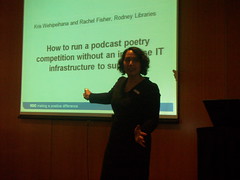
How to run a podcast poetry competition

Kris Wehipeihana - How to run a podcast poetry competition

without an in-house IT infrastructure to support it
Rachel Fisher, Kris Wehipeihana
abstract (pdf)

Covering podcasting; working outside IT infrastructure; social media.

Using Blogger, Twitter, Google Calendar. But if your team isn’t keen it won’t happen.

Linking Montana Poetry Day activities to something that could be pushed out through to school activities. Wrote it quickly.

Clause 4 of terms and conditions – that poems are shared under Creative Commons BY-NC-ND. No questions or complaints from users.

Didn’t have any speaker/microphone/sound cards/file space at all. Most work done on Rachel’s own time and own computer. Used free software. Some shortcomings but advantages outweighed disadvantages.

Blogger as easy to use. Free templates can be customised but not easy if you’re not familiar with html. However there’s lots of instructions available online especially as Blogger is so popular.

Audacity – all you need to know is the location of record, stop, pause, play. Advanced functionality available if you’re technically minded. Save-to-mp3 is an extra file so awkward step for users. Comes included in APNK package.

File hosting – two downsides include: sites require you to sign in regularly or you’ll lose your account. Can also impose file storage and file size limits (but probably not a problem unless your competition is really popular).

Stat counters (eg StatCounter) lets you know how many people are visiting, whether they’re repeat visitors, where they come from again. Google Analytics is another one they use and will use in future.

Last year people could only enter if they had their own equipment; now they have stuff through APNK it’s opened things up for everyone. APNK should be self-managing but customers still ask librarians for help, so librarians require training.

Rodney Libraries uses a yahoo email address because their staff email has size limits – it also ties in with their Flickr account.

File hosting sponsor this year is Liquid Silver.

Ideal set up would have dedicated website where customers can fill in mandatory information and upload files directly. Computers would have all equipment and software preloaded; staff would be fully trained. Significant relationships with local schools to combine curriculum areas (technology, english, etc). One school in Rodney catchment area has more classes participating each year.

Intends to maintain presence in web2 sites so as to be in a good position when demand for these services increases.

First year had 32 entries; second year 56. (50 entries in short story competition, for comparison.)

Tim Spalding asked whether they’ve looked at sites where people can post poems and have them critiqued.

Some difficulties in first year of competition re dialup – but it could be done, so don’t let dialup be your excuse not to do it!

Kei hea te taunga mai o aku kupu?

(Where will my words rest?)
Terehia Biddle
abstract (pdf)

Archives NZ is official repository for Treaty of Waitangi and other historical documents.

Relationship objectives with Māori

  • Can act with respect but question is whether Māori feel respected.
  • Trust and have confidence
  • [missed two]

Obligations

  • Treaty obligations
  • legislative requirement under Public Records Act 2005
  • Waitangi 262 claim (flora and fauna) with respect to cultural and intellectual property issues – brought against Crown by 6 iwi asserting Crown breach of Treaty by agreeing to international agreements that affect indigenous flora and fauna and intellectual property rights, eg commercialising sacred knowledge

Building blocks

  • Statement of intent – responsiveness to Māori as a strategic priority
  • business planning documents and performance measures have sections covering responsiveness to Māori
  • Individual performance-based reviews from the general manager down

It’s hard to build a relationship with Māori if internal infrastructure isn’t set up to support it.

In last 5 years has been an increase in the number of iwi requests seeking assistance to support their efforts to access information; increase in number of iwi/hapū organisations seeking solutions in management of iwi records and information. Recognise that there’s an ongoing expense attached to maintaining records. Looking at working collaboratively. Some movement from full repatriation to virtual repatriation.

Important to have conversation first rather than make assumptions about where conversation is to go. Easy to forget the large population group you’re serving when you’re dealing with just a few people face-to-face.

Opportunities

  • establish precedent for future Māori-ArchivesNZ relationships
  • create win-win situations between ArchivesNZ and Māori
  • Hands-on cultural awareness training for staff

Projects they’ve worked with:

Kai Tahu – pilot project selecting items that local hapū Ngāti Tūahuriri had. Turned out they had a system set up so ArchivesNZ only needed to create hyperlinks and they could make sure that information that was only for their people would remain secure; whereas information that could be shared with the public could be made public. Was some concern about how much information should be shared. Some didn’t feel comfortable sharing it; others pointed out that their people lived across the globe. So now have mechanisms in place for those who can prove whakapapa.

Currently Taranaki Reo revitalisation Project. -Language identified as being in state of decline. Identifying and digitising records.

Tūhoe project to identify historical records re land area now known as Te Urewera National Park.

Common themes:

  • one size doesn’t fit all
  • Māori are clear of where they want to be positioned in the work, discussions and decision-making process
  • aware of significant role ArchivesNZ can play in Treaty claims
  • want to be part of solution

Guiding principles

  • build a strong relationship with māori
  • competency in te reo and (local) tikanga adds to credibility
  • kaumātua provide guidance and advice – to get into communities, and talk to people, kaumātua open the door
  • iwi determine the scope for the research
  • iwi determine the criteria for quality of data – needs to be Māori-intuitive
  • involved in all phases of project, determining milestones, etc
  • iwi-nominated kairangahau (researchers) are appointed to do the work.
  • protocols re distribution of product rests with iwi
  • work conducted in a culturally appropriate way
  • database that identifies items of significance needs to comply with ArchivesNZ standards and meet needs of iwi
  • don’t compromise originals
  • be clear about what is possible
  • when necessary, say no – gently
  • manage expectations and relationships well

Questions
Q re breakdowns in relationship
A: it occurs mostly when we let our ego get in the way and aren’t willing to say we’re wrong. Need to keep focus not on ourselves / our department, but on people we’re wanting to encourage.

Q re records that might be borderline on what should and shouldn’t be accessible
A: records will always be controversial, it’s a matter of interpretation, fortunately iwi-nominated researchers pull out only records that they believe are of significance to them, so it helps that they’re the ones making the decision.

Q re pay of researchers
A: Up to recently salary came from ArchivesNZ baseline budget. The researchers come in and learn all the jobs there so leave with good experience too.

Q re whether there’s any homogenisation of Māori viewpoint vs iwi differences in a national organisation
A: Not their job to make judgement, it’s about each iwi. Each iwi have their own mana.

Q re Māori-intuitive finding aids
A: Have been working on this since the Tainui project – this became the platform on which they can improve so they now have a template. 16 fields to complay with professional standards, now have added to this fields to include names of people and places mentioned in the records. Have tried to keep it simple as are looking to the database being usable by pākehā colleagues.

Copyright vs community in the age of computer networks

Richard Stallman (homepage)
abstract (pdf)

Brenda Chawner, chair, says Stallman is “The most influential people no-one has ever heard of.”

Talking about whether the idea of free software extends to other works. User deserves:

  • Freedom 0 – to run the program
  • 1 – to look at source code, verify what it’s doing, fix it to make it work as you need
  • 2 – to help friends by sharing software with them
  • 3 – to help community by publishing changes to software

If one of these freedoms is missing then it’s proprietary. This keeps users divided and helpless.

Text isn’t the same exactly as software – no source code. So mostly affected by copyright. This has developed along with copying technology. Originally had no economy of scale – ten copies took 10 times as long as 1 copy. Copies were made in a decentralised manner. Anyone who had a copy and wanted to copy it could. –Unless the local ruler didn’t like the book, “but that’s not copyright, it’s something closely related, which is censorship”.

Printing press has economy of scale. Took time to set up, required money and skill, but once it was set up you could produce many many copies. So copies were made in a centralised manner. And this is when copyright began. In England it began as a method of censorship in 1500s (originally to censor Protestants, then to censor Catholics). You’d apply to crown and get perpetual monopoly to publish a title. This was abolished, and in the 1680s reestablished as a temporary monopoly for the author of 14 years. It was a means of promoting writing.

When US Constitution was written they decided that Congress could optionally adopt a copyright law in order to promote progress, and it must last a limited time.
In time of digital technology, one-off copying has benefitted so we’re back almost to the time of decentralised copy-making. Copyright is no longer adapted to the technology. It’s now a restriction on the public, controlled by publishers in the name of authors. “It’s no longer easy to enforce, no longer uncontroversial, and no longer beneficial.”

Copyright is supposed to encourage authors to write more – but how does extending copyright in 1998 encourage the authors of the 1920s to write more? And the value of 20 years of copyright 70 years in our future is too small to actually change anyone’s actions. The real reason of the law is that certain companies have lucrative monopolies and want them to continue.

Originally copyright regulated certain activities while others were simply allowed. Now, companies want to set up a pay-per-universe by turning our computers against us using DRM. First by technology, until people figured out the formats and published free software – then by law, by criminalising this software. Then by technology again. Stallman says that a conspiracy to control our computers in this way should be prosecuted to price-fix.

AACS was broken and the key was published (illegally) by being included in a photo with cute puppies so it got shared faster than it could be deleted. (cf also this story)

Blue Ray. “Corrupt disks” will play in audio players but not on a computer. Sony discs install a program to take control of your computer, to hide itself and resist deletion – these are crimes. Also included GNU code which was on a GNU copy-left license – which Sony didn’t comply with. People sued Sony but focused on these specific crimes instead of on their evil purpose.

Fortunately music DRM is receding. But we’re seeing a renewed effort to impose DRM on books. First by taking away freedoms from ebooks; second by convincing people to switch from print books to ebooks.

Publisher wanted to get Stallman’s biography as an ebook to promote their line. He said only if it’s not encrypted. They wouldn’t do it. Eventually he found a publisher which would.

He thinks probably the reason there’s so many stories about electronic ink is companies want us to get excited about ebook readers – which have DRM, backdoors, spyware. Eg Amazon knows everything you’ve bought on the Kindle. You can’t lend it, can’t sell it to a used bookstore, and Amazon can delete your book (which they’ve done with 1984).

“They want to create a world where nobody lends books to anybody anymore.”

Encourages us to spread the message that by using these devices, “Other readers will no longer be your friend” because we’ll be acting like a jerk by having them in a non-sharable form.

He’s happy with an ebook reader which runs free software, no DRM, doesn’t have backdoors, restrict your files. It’s possible to have such a thing. But the companies pushing ebooks “are doing it to attack our freedom and we mustn’t stand for that.”

Stallman says:

  • Copyright should last 10 years from date of publication. The publication cycle has got shorter and shorter – almost all books are remaindered in 2 years and out of print in 3. (Was once on a panel with a fantasy author who said 10 years was intolerable – it should be 5! He wanted to distribute his own book.)
  • Functional works (software, recipes, educational, reference) should be free – these are necessary for your life. (Imagine if the government tried to stamp out “recipe piracy”. Points out that attacking ships is bad, sharing with people is good, so should reject propoaganda use of term ‘piracy’.) Works will still get made – cf recipes, Wikipedia, etc.
  • Works about what people thought – eg diaries, letters, memoirs – should allow noncommercial redistribution of exact copies.
  • After 10 years goes into public domain and you can publish your modifications.
  • Remixing snippets from many places should be legal outright.
  • Sharing copies on the internet should be legal.

“To attack sharing is to attack society.”

Also proposes:

  • Distribute tax revenue directly to artists to promote the arts. This means not in linear proportion to popularity. Based on popularity, yes (eg through polling) and then take the cube root – so 1000x more popular would get 10x as much money.
  • Voluntary payments – micropayments so you could send a dollar anonymously to the artist of the song you’re listening to. You could get a certificate of having supported your favourite artists as encouragement. Make friendly advertising campaigns encouraging “push the button”. (Me: make it a big red button and everyone will want to push it!) Need a good system.
3M Award for "Innovation in Libraries" Finalists Presentation

(Presentations available online)

Auckland City Libraries with the Active Movement programme – biggest problem now is where to park the buggies because it’s so popular. Including video of snippets of the sessions including bubble-blowing. 🙂 SPARC will sponsor this in 50 libraries across greater Auckland area, starting today.

Aotearoa People’s Network Kaharoa (on whose wireless network those of us with laptops are connected!) “Kaharoa” is the largest of the nets traditionally used for fishing. Many stories of word-of-mouth bringing in huge numbers of new users to libraries.

Top of the South – “the prow” referring to the canoe that Maui fished up and which became the South Island of New Zealand. Local providers used. Community continually adding content, comments. Many plans for website to add functionality (RSS, GIS) and content.

Generation Ngai Tahu

Hana O'Regan and Sir Tipene O'Regan

Sir Tipene O’Regan and Hana O’Regan

The Whare Mahara – The House of Memories

The house is an acknowledgement of the past; embraces the present, providing a place to gather and collect; and is about future as a legacy to be there for the next generation.

Intergenerational transmission of knowledge – will look at tools, systems etc that have been used transmitting knowledge in Ngai Tahu.

Transmitting knowledge also means loss of knowledge. With the arrival of the potato, the whare arohe, the knowledge, poetry, references of fernroot disappeared. With the arrival of iron saws, the time-consuming process of grinding pounamu was lost. The knowledge of those who lost wars – their poems and stories – is gone. “History always forgets the losers.” — Tā Tipene

Hana says she and her father have very different perspectives. (Her father interrupts to correct “focuses” to “foci”. 🙂 ) Each generation influenced by events and values of their time. Tipene says older generation may have longer view.

Hana defends “she waits for the movie to come out” by pointing out that it’s higher quality than old reels, and in colour, and she has access to a wider range of technologies than older generations had.

Tipene’s father had benefit of his father’s library; his uncle read Gibbons’ Decline and Fall 20 or so times and also a fisherman, but belonged to “an aristocracy of knowledge”. Tipene was exposed to Dickens before he read it as father read it to him when a child. Father: “What’s the use of Latin? None, thank God. Lord preserve us from the tyranny of relevance!” Tipene: “We all handle knowledge differently.”

Structural questions: – selection, determining what we want to know and preserve; loss – do we want to lose it and not-know just because we’re no longer using it.

Pre-European

  • Priorities: maintaining tribal boundaries, survival, whakapapa, mahinga kai
  • Tools: mōteatea, karakia, kōrero o nehe, pūrākau, whakairo

Early settlement

  • Priorities: adaptation (fish hooks and axes, steel replaced stone), globalised knowledge, new worldviews and worlds (sealskins going to China and Māori travelling in those ships), new commerce/production
  • the written word, books, Christianity

Post Ngāi Tahu Deeds/Treaty

  • Priorities: survival, diseases, introduction of an abstract legal code, retaining land, economic sustainability
  • Tools – petitions, letters, presentations to commissioners

Ngāi Tahu Claim

  • Priorities: documenting the Middle Island land claims and securing fulfilment of South Island Purchase contracts
  • Tools: private journals, whakapapa records, manuscripts, petitions, legal documents

Waitangi Tribunal

  • Priorities: collection of information to prove traditional use rights and mana whenua, establishing the tribal base, political organisation, economic sustainability
  • Tools: secondary and primary research, records of oral traditions, oral accounts of sustained practices and traditions, specialist analysis of mahika kai resources

Ngāi Tahu settlement

  • Priorities: commercial viability, maintaining tribal boundaries, understanding development, redevelopment of tribal resources, moving from claim-mode to looking to future
  • Tools: radio, tv, digital media, websites, print, books, magazines (Te Karaka, Te Panui Runaka) – new tools but still missing something.

Move away from process of repetition to transmit knowledge – can now be recorded and stored and retrieved in other ways – print and video. Don’t have to retain knowledge as parents and grandparents did – can Google it.

Knowledge as entertainment – takes it back to the fireside.

Te Reo as an example – language was neglected for a long time. Why did so many generations raised in the language not transmit it to their children? Sir Apirana Ngata argued that the first priorities of education for Māori should be English, English, English. They felt that the community spoke Māori and it couldn’t possibly be lost, so focused on English. This happened to Gaelic in Ireland too, and elsewhere. Hindsight is 20/20….

Languages (47% endangered, threatened or extinct) are far more threatened than birds (11%), mammals (18%), fish (5%), plants (8%). Particularly low statistics of Ngāi Tahu language proficiency among Ngāi Tahu speakers. Hana’s frustrated that language doesn’t feature on the tribal wish-list; Tipene interrupts to say it features on the wish-list all the time – just not on the “must do” list. It’s a systemic problem: you can’t understand place names unless you have Te Reo.

Hana comments on the “PC-ing” of knowledge that is being transmitted. Lullabies used to include quite graphic depictions of past wars and necessary revenge – what it might look like (“or taste like”). Now sanitising a whole body of knowledge by omitting this.

How will Ngāi Tahu decide what knowledge to transmit to their mokopuna? What will they need to know to be Ngāi Tahu, to survive, and prosper? What songs will they sing?

Call back to conference theme – He aha te mea nui o te ao? He tāngata, he tāngata, he tāngata. (What’s the most important thing in the world? It’s people, people, people.)